

A series on how to properly collect customer feedback
Hi and welcome to the 2nd article in The Unbiased Founder series!
In our first post, we looked at why potential customers lie to protect our feelings and introduced a 3-rule framework for unbiased questioning: talk about their life instead of your idea, ask about specifics in the past, and listen more than you talk.
On paper, those three rules look dead simple.
Then you sit down in a real meeting. Ten minutes in, the person across the table asks: "So, why are you asking me all these questions about our deployment pipelines anyway? Are you building something?". Or worse, they might think you are a competitor, so you open up.
You tell them a tiny bit about your concept. Their eyes light up:
"For real?! That is a brilliant idea! We would totally use something like that. Let me know when it launches!"
Your heart rate jumps. Dopamine floods your brain. You walk out of the coffee shop practically floating, message your co-founder on Slack ("Crushed the meeting! They loved it!!"), and add another checkmark to your "Validated" column.
Except you didn't validate anything. You just got handed a big, shiny nugget of Fool's Gold.
In this post, we’ll see why compliments and future-tense promises are actually a very red alert in customer discovery, how we accidentally invite them through the Pathos Problem, and the exact tactical maneuvers to deflect fluff and anchor conversations back to reality.
The Danger of Fluff: Why Praise Carries Zero Bytes of Data
In customer discovery, "fluff" comes in three main disguises:
1. Compliments: "That’s a really smart approach!", "I love the UI!"
2. Future-Tense Promises: "I would definitely buy that when it’s ready."
3. Hypotheticals & Generics: "Whenever we onboard a new developer, we usually try to...", "Companies in our space would pay a lot for that."
As engineers, we are used to dealing with noisy data in our pipelines, telemetry sensors, etc.
If a sensor sends corrupted packets filled with random noise, what does your ingestion pipeline do? It drops the packet. It doesn't store random noise in the database and compute business metrics on top of it!
Yet as founders (and as people also), because we crave approval and psychological safety, we treat compliments as high-value data.
Here is the cold, hard truth: Compliments are entirely worthless and carry zero actionable data.
Even worse, compliments are frequently used as a polite stalling tactic.
Think about the last time a someone fundraising, or street marketing stopped you on the street stopped you. What is the fastest, least confrontational way to escape that conversation and get back to your day?
"Oh, that sounds like a great initiative! Give me your card and I'll check it out when I'm back at my desk."
When an executive says, "That’s a great idea, let me know when it launches," nine times out of ten, that is the polite corporate translation of: "I am not going to give you money today, and I have another call in 10 minutes."
The Pathos Problem: How We Invite the Lies
At the end of our previous article, we discussed about people lying to protect our feelings. Why do they feel the need to protect us in the first place?
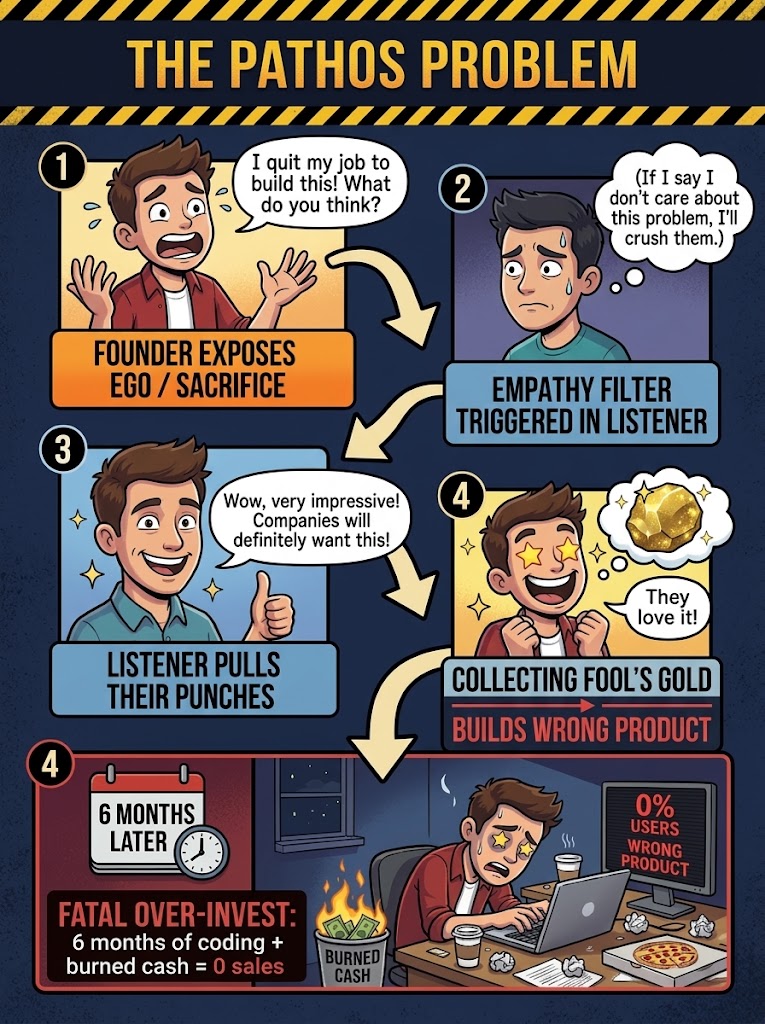
Because we accidentally trigger what is known as The Pathos Problem: exposing our emotional vulnerability and ego so heavily that the other person feels like a monster if they tell us the truth.
Consider how many founders introduce themselves in discovery channels:
- "Hey! I just quit my senior architect job and cashed out my savings to build this platform—what do you think?"
- "My co-founder and I have been working 80-hour weeks for the last four months on this prototype. Take a look!"
- "This is my baby—be brutally honest with me!" (Spoiler: Whenever someone says "this is my baby, be brutally honest," nobody on Earth is going to call your baby ugly).
"What If an Investor or Industry Expert Compliments My Idea?"
One common pushback here is: "Okay Carlos, my mom or a random friend might just be being nice. But yesterday a VP of Engineering—an industry veteran—told me my idea was great! Surely THAT counts?!"
Still no! Unless that VP of Engineering is pulling out a corporate credit card or signing a pilot commitment right now, their compliment about what "the market will want" is still a guess.
Even tier-one venture capitalists—whose entire full-time job is predicting which startups will succeed—get it wrong the vast majority of the time. H
umans are terrible at predicting future market behavior, especially when it costs them 0€ to say "Sounds cool!"
What to Do Instead: The Deflect & Anchor Maneuver
So what should you do when you’re in a meeting—either because you slipped up and pitched, or because the conversation naturally drifted toward your idea—and the other person starts praising it?
Your job is to deflect the compliment, ignore the praise in your notes, and immediately anchor the conversation back to specific facts and past behaviors.
Think of it like exception handling in code:
try:
    customer_response = listen_to_customer()
    if is_compliment_or_hypothetical(customer_response):
        raise FluffDetectedError("Compliment detected: 0 bytes of real data.")
except FluffDetectedError:
    apologize_if_pitched()
    deflect_praise()
    anchor_to_past_specifics()
Sorry, I just miss coding so much these days, that I had to do it.
More seriously now, let’s look at how the Deflect & Anchor Maneuver works across three common real-world scenarios:
| The Fluffy Compliment / Promise | What Your Ego Wants to Say (❌ Don't) | The Deflect & Anchor Response (✅ Do) |
|---|---|---|
| "That's an awesome idea! I'd definitely use a tool like that." | "Awesome! What features would you want to see in v1?" | "I appreciate that! Apologies, I slipped into pitch mode there. Stepping back—how are you currently dealing with this problem today?" |
| "Oh yeah, we ALWAYS struggle with database migrations. It's a huge issue for us." | "Great! Our tool automates schema rollbacks!" | "When was the exact last time a migration went sideways for your team? Can you walk me through what happened that day?" |
| "Let me know when you launch and we'll definitely take a look!" | "Will do! I'll add you to our launch newsletter!" | "Thanks! To make sure I don't waste your time later, what does your team's current process look like right now, and how much is that costing you in engineering hours?" |
Walk through a Live Recovery
Let’s see what happens when you apply this in real time. Suppose a prospect says:
"Honestly, an automated incident post-mortem generator sounds amazing. Our engineers hate writing post-mortems. We’d totally buy that."
Instead of high-fiving them, you run the Deflect & Anchor:
You: "Haha, glad it sounds interesting, though I'm trying not to get ahead of myself! Tell me about the last major incident you had—who wrote the post-mortem, and how long did it actually take?"
Prospect: "Well, our last P1 was about four months ago. Our lead DevOps engineer wrote a quick two-paragraph summary in Slack the next morning. Took maybe 15 minutes."
You: "Gotcha. And did anyone complain that the two-paragraph Slack summary wasn't enough?"
Prospect: "Not really, we're a 12-person startup, so everyone was already in the war room anyway."
Boom. Look at what just happened in 30 seconds of deflecting:
* Five seconds ago, they "loved your idea" and "would totally buy it."
* Thirty seconds later, by anchoring to the last specific incident, you discovered they only have a P1 once every four months, it takes 15 minutes in Slack, and nobody in their 12-person company actually cares about formal post-mortems!
You just saved yourself months of chasing a phantom customer.
The Elephant in the Room: Craving Approval as a Founder
One of the things that may be bothering you right now is how unnatural this feels.
Let’s be honest: building something from scratch is lonely and stressful. When you spend weeks thinking about a problem, hearing someone say "Hey, that’s really smart!" feels like really good.
Deflecting that praise and intentionally poking holes in your own validation feels like masochism.
Why do we have to be so ruthless with compliments?
Because the market will be ruthless when you launch. Paying customers don't buy software out of politeness. If a false compliment tricks your team into believing you have validated a product, you will spend six months building in confidence—only to launch and discover that your "supporters" were just being polite.
Here is the mental shift that helped me: Detach your ego from the initial idea, and attach your ego to finding the truth. You aren't trying to prove your first guess was right; you're a detective trying to find out where the real pain is hiding.
In the real workd: The "Zero-Compliment" Rule for Meeting Notes
How do you keep fluff from contaminating your product roadmap? Apply strict schema validation to your meeting notes:
- Ban Praise from Summaries: If you finish a call and tell your co-founder, "The call went great, they really liked the concept," your co-founder should immediately reject the report. "They liked it" is not a valid metric.
- Log Only Past Verbs and Numbers: Your notes should only contain past-tense actions ("Spent 6 hours last Tuesday debugging X", "Paid $400/mo for Tool Y but canceled it in May") and current budget/workflow facts.
- Treat "Keep Me Posted" as a Soft Rejection: Unless a prospect is willing to examine their current workflow in detail or commit time/money (which we’ll tackle in Post #6), mark them as cold.
Wrap-Up & What's Next
Never build a business on a foundation of compliments:
* Compliments, future promises, and hypotheticals are fluff—they carry zero actionable data.
* Avoid the Pathos Problem: Keep your ego out of the conversation so people don't pull their punches.
* Deflect and Anchor: When someone compliments your idea, thank them briefly, ignore the praise, and anchor back to "How are you dealing with this problem right now?"
Now, what happens when a customer goes beyond giving you a compliment and starts designing your product for you?
"You know what you should build? If you add a custom Excel export and a Jira two-way sync, I’d buy it tomorrow!"
Should you immediately add those features to your backlog?
In the next article, Digging Beneath Feature Requests – The Unbiased Founder #3, we’ll see why obeying customer feature requests is a fast lane to feature creep, and how to dig down to the real root cause.
I hope this helps you spot "fool's gold" in your future conversations. Cheers! 🙂
Comments (0)
No comments yet. Be the first to share your thoughts!
Leave a Comment